By Craig Dunham September 12, 2026
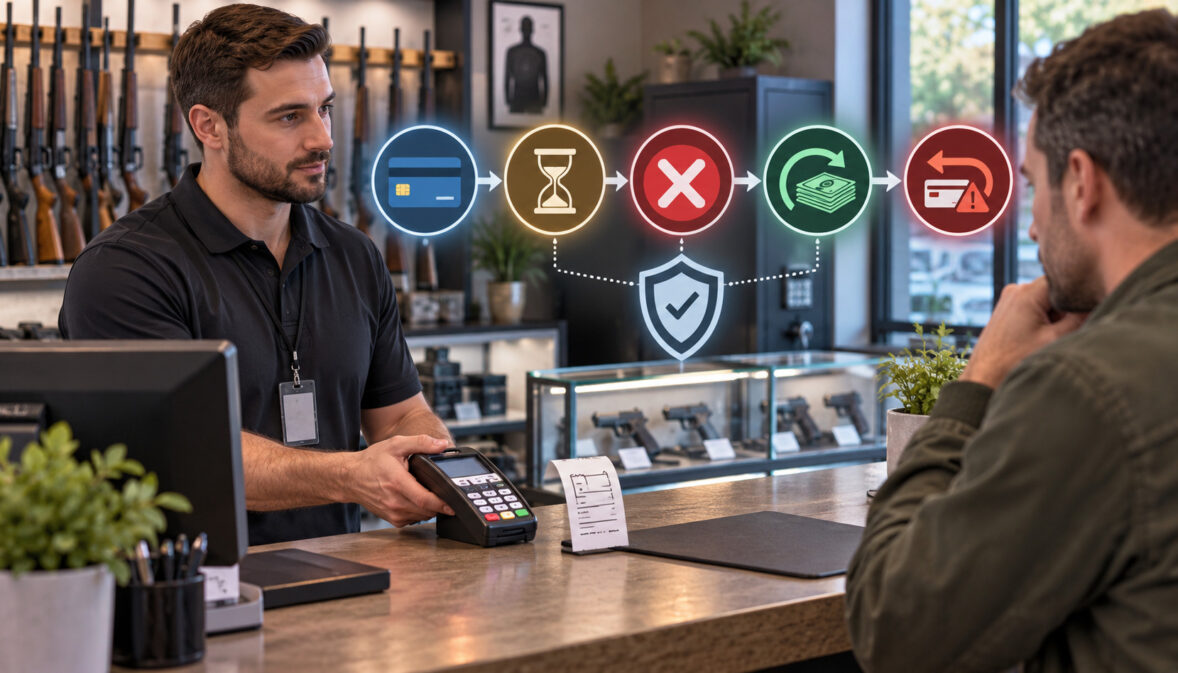
A workable NICS denial refund policy for a gun store starts with one operational principle: payment approval and firearm-transfer approval are separate events.
A successful card authorization does not make a firearm eligible for transfer. Likewise, a NICS response does not tell a merchant how long a card authorization will remain usable, whether a processing fee will be returned after a refund, or how the acquirer expects a cancelled transaction to be handled.
That separation matters whenever a firearm transaction receives a Delay or Deny. The store needs to know whether the customer has already been charged, whether inventory remains reserved, what happens if an authorization expires, what refund or cancellation terms apply, and what records should be preserved if the customer later disputes the payment.
Under current FBI guidance, NICS may return Proceed, Delay, or Deny. A Delay means additional research is needed; it is not the same thing as a Proceed.
Federal law contains a delayed-transaction framework, but state law and other federal requirements can impose additional restrictions. Retailers therefore should never describe expiration of a federal waiting period as a guaranteed transfer date.
The payment workflow should instead be designed around uncertainty:
Order → disclosed payment terms → authorization or capture → required transfer process → Proceed, Delay, or Deny → payment/inventory adjustment → lawful transfer or financial resolution → record retention.
The details below focus on that payment and refund workflow. FFLs should continue following current FBI, ATF, state, and local requirements before transferring any firearm.
NICS Proceed, Delay, and Deny: What They Mean for the Payment
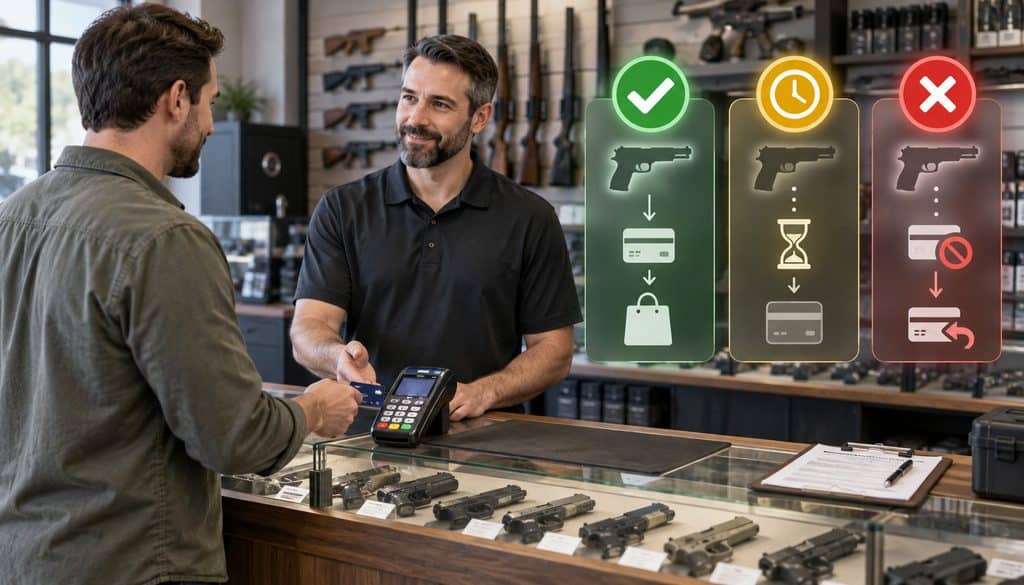
The FBI describes three core NICS responses that matter to an FFL’s transaction workflow: Proceed, Delay, and Deny. The FBI’s official NICS information should be the retailer’s primary reference for current federal NICS procedure rather than employee assumptions or outdated store notes.
From a payment perspective, each status creates a different operational question.
Proceed means the NICS response itself does not prevent the transaction from moving forward, but the retailer still must satisfy every other applicable federal, state, and local requirement before completing the transfer. A Proceed is therefore not the same thing as “payment complete and firearm released.”
Delay means the transaction moves into a pending state. The FBI needs additional time to research potentially relevant information. That uncertainty is exactly why the POS should not use a generic status such as “approved” for both card authorization and transfer status.
Deny means the firearm may not be transferred based on the current NICS result. ATF guidance states that an FFL may not transfer a firearm where NICS issues a denied response.
What happens to the customer’s money, however, depends on a different set of questions: Was the charge already captured? Were cancellation terms disclosed? Is a lawful fee applicable? Was the item specially ordered? What do state consumer laws and the merchant agreement permit?
Table 1: NICS Outcome vs. Payment State
| Outcome | Transfer Status | Payment Question | Merchant Action |
| Proceed | May continue if all other requirements are satisfied | Is payment authorized or captured? | Complete payment according to the disclosed policy and lawful transfer workflow |
| Delay | Pending | Is money captured, merely authorized, or not yet charged? | Place transaction in a documented pending state and track authorization/inventory separately |
| Deny | Transfer cannot proceed on current result | What refund or cancellation terms apply? | Stop the transfer and resolve the payment according to lawful, pre-disclosed terms |
| Customer cancellation while pending | No transfer | Is a cancellation fee permitted and disclosed? | Apply only terms that are lawful and actually part of the agreement |
| Authorization expires while pending | Transfer still unresolved | Can the old authorization still be captured? | Follow processor rules; obtain fresh authorization when necessary rather than treating the old approval as indefinite |
The Federal Delayed-Transaction Framework Is Not a Payment Rule
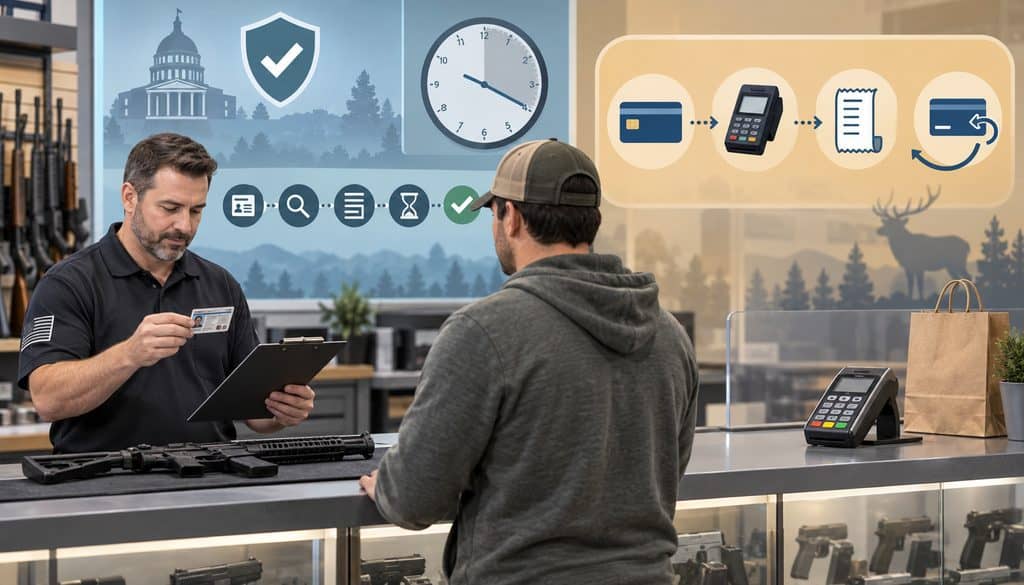
The federal delayed-transaction framework needs to be understood because it affects how long payment may remain unresolved, but it should not be converted into a customer promise.
Current ATF guidance states that, after a delayed response, federal law generally prevents transfer during the initial statutory period unless NICS provides a Proceed sooner. Federal rules can permit transfer after three business days have elapsed when the required conditions are satisfied, but that framework has important qualifications.
Current rules also contain additional procedures that can extend the federal review period in certain transactions involving transferees under 21. State law may independently prohibit or postpone the transfer.
For payment operations, the important lesson is simpler:
Delay does not equal guaranteed future approval.
An employee therefore should not tell the customer that the firearm “will definitely be released after three days.” The legally relevant period depends on the facts, the current federal requirements, the information communicated by NICS or the state point of contact, and applicable state law.
ATF’s current materials also explain that a NICS check is generally valid for 30 calendar days from the date recorded for the check. That is another reason the compliance workflow and payment workflow cannot be allowed to drift indefinitely without review.
The retailer’s payment policy should consequently describe the transaction as contingent on completion of all applicable transfer requirements rather than describing a particular date as automatically creating an entitlement to the firearm.
For current dealer-side requirements, use ATF’s current Form 4473 and transfer guidance and the relevant current state authority.
Payment Approval and Firearm-Transfer Approval Are Different Systems
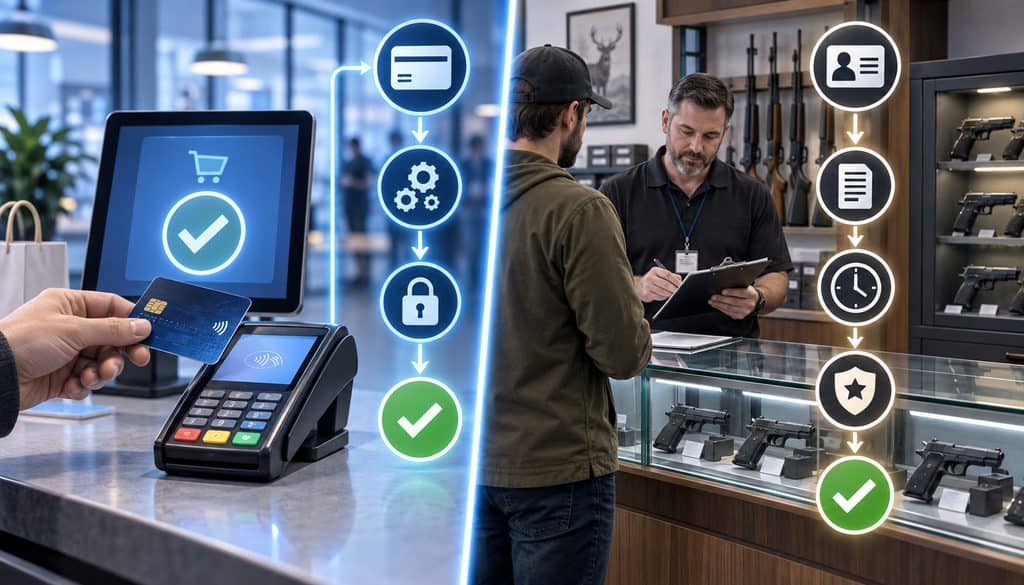
One of the most important controls an FFL can implement is teaching every employee this equation:
Payment status ≠ firearm-transfer status.
A card authorization means the payment system received approval for a particular transaction under the card issuer, network, processor, gateway, and merchant-account rules that apply to that transaction.
It does not mean NICS approved anything.
Similarly, a NICS Proceed concerns the transfer process. It does not mean the buyer’s card remains authorized, that the gateway can still capture an authorization from several days earlier, or that a previously declined payment should now be considered successful.
The systems can therefore produce combinations such as:
- payment authorized + transfer delayed;
- payment captured + transfer denied;
- transfer may lawfully continue + card authorization expired;
- payment refunded + transfer cancelled;
- transfer completed + payment captured.
This distinction should also appear in the retailer’s technology configuration. A gun-store POS needs more than basic checkout functionality because serialized inventory, payment events, and compliance events frequently need to remain distinct.
Useful POS and inventory-control features for firearm retailers should support separate operational states rather than collapsing everything into “sale complete.”
Should You Charge the Card Before or After the Background Check?
The question charge card before or after background check does not have one universal answer.
Payment timing is generally a commercial and processor issue, while lawful firearm-transfer timing is governed by separate federal and state requirements. The correct setup therefore depends on the retailer’s sales channel, inventory model, processor capabilities, authorization rules, cancellation policy, and state-law environment.
Three models are common.
Table 2: Payment Timing Models
| Model | Advantage | Drawback | Best Operational Fit |
| Charge at order | Simple ecommerce accounting; inventory commitment is immediate | Refund volume can be higher when transfer cannot be completed | Merchants with strong refund controls and clearly disclosed terms |
| Authorize first, capture later | May avoid settling some transactions that never reach transfer | Authorization can expire before the transaction is ready | Short, predictable fulfillment cycles with gateway support |
| Deposit + balance | May help cover a legitimate special-order commitment where lawful | More complex disclosure, refund, accounting, and dispute handling | Limited situations with legal review and processor support |
No FFL should adopt one merely because another store uses it.
Processor underwriting also matters. Firearm retailers can face account-specific restrictions around ecommerce, delayed fulfillment, transaction amounts, reserves, or gateway functionality. That is why industry-specific high-risk underwriting requirements should be considered when choosing the transaction model.
Charge at Order
Under a charge-at-order model, the customer pays when the transaction is initiated.
Operationally, this is straightforward. Inventory can be committed, the settled amount is known, and ecommerce software does not need to maintain a long-lived open authorization.
The drawback appears when the transfer cannot be completed.
A Deny, customer cancellation, state-law issue, or other failed transfer can require a refund. Depending on the merchant’s pricing agreement, some original payment-processing costs may not be returned. The merchant may also face customer frustration if the buyer assumed the payment meant the transaction was guaranteed.
The store should therefore make the contingency obvious before the charge occurs.
A useful disclosure is conceptually simple: payment reserves or purchases the merchandise according to the store’s terms, but possession remains contingent on completion of every required transfer condition.
Authorize First and Capture Later
An authorization-first model can reduce the number of transactions that must later be refunded because the card is not fully settled immediately.
But an authorization is not a permanent placeholder.
Card networks, processors, gateways, transaction types, and merchant configurations apply specific processing and authorization rules. Waiting too long can result in an authorization that can no longer be validly captured.
Visa’s current public rules, for example, contain transaction-specific authorization and processing timeframes rather than one indefinite authorization period.
The practical workflow should therefore be:
authorization active → transaction becomes ready for lawful completion → capture under processor rules
or:
authorization no longer usable → obtain a new authorization as appropriate → continue only if the transaction remains lawful.
Do not invent a universal “seven-day authorization” or similar rule. Confirm the exact behavior with the gateway and acquirer actually handling the merchant account.
How to Handle Payment During a NICS Delay
A delayed NICS transfer payment should automatically move into a pending workflow rather than becoming an improvised decision at the counter.
The store should already know the answers to these questions before the first Delay occurs:
Is the firearm reserved? Has the customer been fully charged? Is the transaction only authorized? When will the authorization be reviewed? What happens if the customer cancels? What happens if NICS later returns Deny? How are special orders treated? Does a state waiting period extend the practical hold?
None of those questions should require a salesperson to invent a policy while a customer is standing at the register.
A Delay also should not become an open-ended accounting item. A store with dozens of pending transactions needs a daily or weekly exception report that identifies which ones need review.
Table 3: Delay Aging Controls
| Status | Authorization | Inventory | Next Review |
| Newly delayed | Active or captured | Reserved according to policy | Confirm customer received pending-status explanation |
| Delay continues | Check current payment state | Continue hold only under stated policy | Review processor authorization and state-law implications |
| Authorization nearing processor limit | Needs action | Still reserved if policy allows | Determine whether fresh authorization will be required |
| Customer cancels | Reverse/refund as applicable | Return to stock when legally/operationally appropriate | Apply lawful disclosed cancellation terms |
| Deny received | Do not transfer | Return or reclassify inventory under store process | Resolve refund/cancellation amount promptly |
| Long unresolved transaction | Review needed | Verify continued reservation | Management/compliance review |
The inventory policy can be simple. For example, the written terms might say that merchandise remains reserved while the transaction is pending, subject to defined cancellation or special-order provisions.
The important part is consistency.
A store that holds one customer’s firearm indefinitely but resells another customer’s merchandise after two days creates unnecessary conflict. It also makes customer-facing disclosures difficult to defend.
Writing a NICS-Contingent Refund and Cancellation Policy
A strong NICS denial refund policy gun store customers can understand should explain what happens before, during, and after the transfer process.
It should not attempt to rewrite firearm law. Its job is to define the commercial terms surrounding a transaction that remains legally contingent.
The policy should generally address payment timing, inventory reservations, Delay handling, Deny handling, cancellation, special orders, any lawful fees, refund method, and how the customer will be notified.
It should also state clearly that a purchase or payment does not guarantee that a firearm may be transferred.
Retailers operating online have an additional reason to make those terms prominent. Ecommerce payment, fulfillment, and transfer events can happen at different times, and the payment provider itself must support the business model.
A suitable online payment setup for licensed firearm retailers therefore needs both compliant transaction handling and clear conditional-fulfillment terms.
Table 4: Refund Policy Components
| Term | What the Policy Should Explain | Why It Matters |
| Transfer contingency | Possession depends on completion of applicable transfer requirements | Prevents payment from being mistaken for transfer approval |
| Payment timing | Whether card is charged, authorized, or partially collected | Sets customer expectations |
| Delay handling | Payment and inventory status while pending | Reduces uncertainty and employee improvisation |
| Denial handling | How the financial transaction is resolved | Central to dispute prevention |
| Cancellation | What happens if customer cancels | Avoids after-the-fact fee arguments |
| Special orders | Any different treatment for specifically ordered merchandise | Supports consistent expectations |
| Restocking/cancellation charge | When it may apply and how it is calculated | A fee is harder to defend if never disclosed |
| Refund method | Where card refunds are normally sent | Supports transaction matching |
| Timing | When the merchant initiates an approved refund | Separates merchant action from issuer posting time |
The best time to show these terms is before payment.
A policy that first appears when the customer is denied is far weaker operationally than one presented at checkout, acknowledged in online terms, and referenced again on the receipt or order confirmation.
Restocking Fees and Special Orders
A firearm sale refund restocking fee should never be treated as automatically enforceable simply because the merchandise is regulated.
Whether a cancellation or restocking charge is lawful and defensible can depend on state consumer-protection law, the contract, the nature of the transaction, whether the merchandise was specially ordered, what expenses the seller actually incurred, and whether the customer accepted the terms before payment.
Processor and card-network dispute rules also matter.
An FFL therefore should not adopt language such as “all NICS denials lose 20%” simply because another retailer uses it. There is no universal percentage that is automatically lawful or chargeback-proof.
The same caution applies to the word nonrefundable.
Calling money “nonrefundable” does not override state law, card rules, or an inconsistent contract. Have cancellation and deposit provisions reviewed for the jurisdictions in which the retailer operates.
Special-order firearms may justify different commercial terms where law and processor policy permit them, but those terms should be presented before the order is placed—not invented once the product arrives.
Refund to Original Card vs. Store Credit
When a captured card purchase must be reversed, refunding to the original payment credential normally creates the cleanest transaction trail.
It links the original sale and the credit, gives the processor a straightforward reconciliation path, and provides the customer with a matching credit through the same payment account.
Current Visa rules state that, to the extent possible, a merchant providing a refund for a previous purchase must process the credit to the same payment credential used for the original transaction, with specified exceptions when that credential is unavailable or the refund cannot be processed to it.
See the current Visa public rules on refunds and transaction processing for the network’s current detailed requirements.
This does not mean every network, acquirer, or unusual payment scenario operates identically. Follow the merchant’s actual processing agreement.
Store credit can be appropriate where the customer voluntarily chooses it and applicable law and policy permit it. It should not be forced on a customer who is legally or contractually entitled to a monetary refund.
Cash refunds against card purchases should be handled cautiously. Improvised cash refunds can create fraud and reconciliation problems because the payment network may still show the original card charge as outstanding.
Table 5: Refund Methods
| Method | Benefit | Dispute Risk | Caution |
| Original card | Strong transaction linkage | Generally easiest to document | Follow processor/network rules |
| Replacement/secondary credential where permitted | Can resolve unavailable original account | Requires specific network support | Do not improvise |
| Store credit | Keeps value with retailer | Customer may still dispute original charge | Use only when voluntarily accepted and lawful |
| Cash/check | May be permitted in limited circumstances | Original card transaction remains harder to match | Follow acquirer/network rules |
| Split-tender refund | Mirrors multi-method purchase | Can become confusing | Predefine allocation and document it |
The merchant should initiate an owed refund promptly under its stated policy. The time it takes to appear on the customer’s statement can depend on the issuer and payment system, so employees should avoid guaranteeing an exact posting date unless the provider has supplied one.
Authorization Expiration During Long Delays and Waiting Periods
Authorization-then-capture works only if the authorization remains usable when the merchant is ready to submit the transaction.
That assumption becomes risky when NICS research, state waiting periods, fulfillment, customer scheduling, or other legal requirements extend the transaction.
Card authorization rules are not one universal number. Visa’s public rules themselves contain multiple transaction-specific processing timeframes, and an acquirer or gateway can impose additional operational requirements.
The store should therefore build an expiration control into its POS or order-management process.
A pending transaction could contain fields for:
- authorization date;
- gateway authorization ID;
- capture status;
- processor review date;
- transfer status;
- inventory status;
- customer-contact status.
If the authorization becomes unusable before the transaction is legally ready, the answer is not to force or manipulate the old transaction.
The merchant should follow processor instructions for obtaining fresh payment authorization, while independently confirming that the firearm transaction still meets every applicable transfer requirement.
This becomes especially relevant for stores using ecommerce systems or gateways with conditional fulfillment. Payment compliance for changing processor and regulatory requirements should include documented handling of expired authorizations rather than relying on staff memory.
How State Waiting Periods Affect Payment Timing
Federal NICS timing is not the ceiling on firearm-transfer restrictions.
The FBI expressly notes that even where the federal delayed-transaction framework would otherwise permit an FFL to make a transfer, state law can prohibit the transfer. ATF’s current Form 4473 materials likewise make state-law compliance part of the analysis.
That matters to payments because a state requirement can extend the period between the initial order and lawful transfer.
An authorization-first model that works smoothly for a short transaction may become impractical when a longer state-required period applies. Conversely, capturing payment immediately can increase the number of refunds if another transfer requirement later prevents completion.
A multi-state retailer should therefore avoid building one payment workflow around the assumption that the federal timeline is the only relevant clock.
Instead, maintain a state compliance matrix outside the customer-facing payment system and have counsel or qualified compliance personnel verify changes.
Payment software should then support the consequences of those rules—such as longer pending status, authorization review, and inventory holds—without attempting to decide legal eligibility itself.
Employees also should not tell customers, “Federal law says we can always transfer after X days.” The correct statement is that the store will follow the current federal, state, and local requirements applicable to the transaction.
4473 Payment Timing: Keep the Records in Their Proper Lanes
The phrase 4473 payment timing can create confusion because Form 4473 and a payment receipt perform different jobs.
ATF Form 4473 is part of the federal firearm transaction and recordkeeping process. Card authorization, settlement, refunds, and receipts belong to the merchant’s payment system.
Federal firearm rules do not create a universal requirement that every retailer must charge a customer’s card at one particular moment in the transaction.
Instead, three systems need to work together:
- the store’s commercial payment policy;
- processor/network rules governing authorization and capture;
- firearm-transfer requirements governing when possession may lawfully change.
Do not turn Form 4473 into the store’s payment receipt.
Likewise, do not use the POS receipt as a substitute for required firearm records. Maintain each record according to its proper purpose and applicable retention requirements.
ATF states that licensees must record the relevant NICS response information and transaction number on Form 4473 as required, including subsequent information associated with delayed transactions.
Payment systems, meanwhile, should generally store transaction IDs, authorization references, capture amounts, refund references, and policy acknowledgments without unnecessarily copying sensitive firearm-record information into the payment ledger.
Ecommerce, Special Orders, Deposits, and Split Tender
Ecommerce creates additional separation between the time money moves and the time a lawful transfer can occur.
An order may be placed online, a card transaction may be initiated, merchandise may move through a distribution chain, and the actual transfer may occur later through the appropriate licensed dealer.
From a payment perspective, the merchant therefore needs terms covering cancellation, special-order costs, shipping-related consequences, transfer failure, and refund routing.
Those terms should not explain how to acquire or transfer a firearm. They should explain what happens to the financial transaction when the underlying order cannot be completed.
Deposits require similar care.
The policy should say whether a deposit is refundable, under what circumstances it becomes earned, and how a cancellation is handled. State contract and consumer laws can affect whether that language is enforceable.
Split-tender transactions should also have a predefined refund rule.
If a $1,000 transaction involves $700 on a card and $300 in another tender, staff should not decide after a Deny that the entire refund will be issued using whichever method is easiest. Refund allocation should follow processor rules, documented policy, and applicable law.
Avoiding Chargebacks When the Transfer Cannot Be Completed
The typical chargeback denied gun purchase pattern is easy to understand:
customer pays → transfer does not occur → customer and store disagree over refund → customer disputes the card charge.
The best chargeback strategy begins before the payment is accepted.
It is much easier to document a transaction when the retailer can show that the customer was told the purchase remained contingent on lawful transfer, saw the applicable cancellation terms, accepted them, received consistent receipt language, and was promptly informed when the transfer could not occur.
Visa’s merchant dispute guidance likewise emphasizes clearly stating return, refund, and cancellation policies at the time of transaction.
A hidden website footer is weaker operational evidence than a policy presented directly during checkout and acknowledged where practical.
A signed acknowledgment does not guarantee that an issuer will reject a dispute, but it can make the record considerably clearer.
What Evidence to Preserve
The evidence package should remain payment-focused.
Table 6: Chargeback Evidence Package
| Evidence | What It Proves | Privacy Caution |
| Order confirmation | What was purchased and when | Remove irrelevant sensitive information |
| Card transaction receipt | Amount and payment event | Protect full account data |
| Accepted cancellation/refund policy | Customer received relevant terms | Include the version in effect at checkout |
| Timeline of transaction events | Shows authorization, Delay/Deny, cancellation, refund | Use neutral operational descriptions |
| Customer communications | Shows what was explained | Include only relevant messages |
| Refund transaction record | Demonstrates funds were credited | Include processor reference where useful |
| Inventory/cancellation record | Supports business workflow | Avoid unnecessary firearm details |
Do not automatically upload an entire Form 4473 to a processor merely because a chargeback arrived.
A payment dispute does not erase the sensitivity or regulatory significance of firearm records.
Ask the acquirer what evidence is actually needed. Provide the minimum documentation necessary to establish the payment facts, and consult qualified legal/compliance personnel if disclosure of a regulated firearm record is being considered.
Refund Before Fighting the Chargeback
If the merchant actually owes the customer a refund under applicable law and its policy, the first goal should be issuing the refund—not building an aggressive representment package.
Prompt resolution can prevent some disputes from arising in the first place.
If the customer disputes after the refund has already been processed, the merchant should provide the processor with the refund transaction evidence through the proper dispute channel.
That matters because otherwise the merchant risks a duplicate financial loss: the customer receives both the merchant’s refund and the value of the chargeback.
Do not assume the issuer can automatically see every refund in time to stop a dispute. Keep the processor reference and refund date accessible.
Employee Procedure for Proceed, Delay, and Deny
Front-line employees should not be expected to improvise legal or payment explanations.
A short lane procedure is safer.
If the result is Proceed: staff follow every remaining transfer requirement and the store’s normal payment procedure. A Proceed does not override another applicable legal restriction.
If the result is Delay: staff move the order to pending, explain the current payment and inventory status, and avoid promising when the transfer will occur.
A neutral customer statement is:
“Your transaction is currently delayed. We’ll follow the required transfer process and our written payment and hold policy. We’ll contact you when the status changes or another action is required.”
If the result is Deny: staff do not proceed with the transfer and move the transaction into the established refund/cancellation workflow.
A neutral response is:
“We cannot complete the transfer based on the current result. We’ll now handle the payment according to the refund and cancellation terms provided at checkout.”
Employees should not interpret why a person was denied. Current ATF guidance explains that the dealer generally does not receive the underlying reason for a denial.
They also should avoid statements such as:
- “It will definitely clear tomorrow.”
- “After three days we always transfer.”
- “A denial means you automatically lose your deposit.”
- “The card was approved, so everything is approved.”
- “The refund will definitely appear tomorrow.”
Each statement improperly mixes legal, payment, or issuer processes.
Receipt Language and POS Statuses
A receipt or order confirmation should help the customer understand what happened without attempting to become a legal treatise.
Useful fields can include:
- transaction amount;
- payment status;
- order number;
- refund/cancellation-policy reference;
- brief transfer-contingency notice;
- merchant contact information.
The POS should also distinguish operational states.
Good examples include:
Payment Authorized
Payment Captured
Transfer Pending
Delayed
Transfer Completed
Denied/Cancelled
Refund Initiated
Refund Completed
Avoid a generic status such as “Approved” because employees may not know whether it describes the card or the transfer.
For a retailer building or replacing its processing environment, merchant-account approval and underwriting expectations for FFL dealers should also be considered before designing gateway-dependent workflows such as delayed capture.
How to Reconcile a Denied or Cancelled Transaction
A denied transfer can be financially simple if the payment record is structured correctly.
The accounting trail should generally reconcile:
order amount → captured amount → refund amount → any lawful retained charge → net financial result.
Suppose a customer paid in full but the transaction was later cancelled. The bookkeeping system should show the original captured payment and the resulting refund as linked events.
If a lawful cancellation fee applies, it should have a documented policy basis rather than appearing as an unexplained difference.
Accounting recognition and sales-tax treatment can depend on the jurisdiction, transaction facts, and accounting method, so retailers should not assume every pending firearm order is automatically a completed sale for financial reporting purposes.
A refund log can contain:
- order number;
- payment transaction ID;
- original amount;
- refund amount;
- date refund was initiated;
- processor reference;
- policy basis;
- employee or manager completing the action.
It generally does not need the buyer’s complete firearm record.
Daily Exception Report
Managers should regularly review at least four categories:
- delayed transfers with captured payments;
- delayed transfers with authorizations that need review;
- denials for which the financial resolution is not complete;
- refunds initiated but not reconciled in the processor settlement.
This turns delayed transactions into managed exceptions rather than forgotten orders.
Common NICS Payment and Refund Mistakes
The biggest problems usually begin with inconsistent systems rather than the NICS result itself.
Table 7: Common Mistakes
| Mistake | Payment/Compliance Risk | Better Approach |
| Charging without displaying transfer contingency | Customer assumes payment guarantees possession | Disclose contingency before payment |
| Treating Delay as eventual Proceed | Staff makes inaccurate promises | Keep transfer in pending status |
| Promising a transfer date | State/federal requirements may change the outcome | Describe process, not guarantees |
| Letting authorization expire unnoticed | Capture may fail or violate processor procedure | Track authorization aging |
| Automatically keeping a percentage after Deny | Fee may be unlawful or inconsistent with terms | Review state law and disclosed policy |
| Forcing store credit | Customer may be entitled to monetary refund | Use store credit only when lawful and accepted |
| Cashing out card purchases casually | Fraud and reconciliation risk | Follow network/acquirer refund procedures |
| Different terms online and on receipt | Weak dispute evidence | Maintain one controlled policy version |
| Failing to record refund reference | Harder to prove repayment | Log processor credit transaction |
| Sending full regulated records to processor | Unnecessary privacy exposure | Submit minimum necessary payment evidence |
Practical Payment Workflow for Delayed or Failed Transfers
A retailer can translate the principles above into a repeatable twenty-step process.
- Establish a written transfer-contingent payment policy: Define authorization, capture, cancellation, refund, inventory, and special-order treatment.
- Verify current federal requirements: Use current FBI and ATF materials rather than historical store procedures.
- Verify applicable state and local requirements: Do not assume federal timing controls the entire transaction.
- Choose the payment model with the processor/acquirer: Confirm whether charge-at-order, delayed capture, or another supported setup is appropriate.
- Disclose cancellation and refund terms before payment
- Record the payment state: Distinguish authorization from settlement.
- Conduct the required background-check and transfer process only through lawful channels.
- If Proceed is received, complete every remaining legal requirement before transfer.
- If Delay is received, change the transaction to pending.
- Record the inventory-hold state.
- Track card authorization aging independently of the NICS status.
- Do not promise the customer a transfer date.
- If the transaction remains pending, review authorization and inventory at predetermined intervals.
- If Deny is received, stop the transfer.
- Determine the refund or cancellation amount from the lawful terms accepted by the customer.
- Refund the original payment credential where appropriate under network/acquirer rules.
- Record the refund processor reference and initiation date.
- Send the customer a concise financial-resolution confirmation.
- Preserve only the documentation needed for accounting or a potential dispute.
- Periodically audit the workflow when firearm law, state requirements, network rules, or processor policies change.
NICS Payment and Refund Policy Checklist
Use this checklist when reviewing store procedures:
- Verify current federal transfer requirements.
- Verify applicable state and local requirements.
- Confirm processor and acquirer policy.
- Choose the charge/capture model.
- Define an authorization-expiration workflow.
- Define an inventory-hold policy.
- Define the refund method.
- Review restocking and cancellation terms for applicable law.
- Show material terms before payment.
- Repeat or reference the policy on the receipt/order confirmation.
- Keep payment status separate from transfer status.
- Do not promise a transfer date after a Delay.
- Stop the transfer after a Deny unless the transaction later becomes lawful through the proper official process.
- Initiate an owed refund promptly.
- Link card refunds to the original payment credential where appropriate.
- Preserve the processor refund reference.
- Keep unnecessary sensitive firearm information out of payment records.
- Review chargeback evidence before submission.
- Track delayed transactions on an aging report.
- Audit the policy when federal, state, network, gateway, or processor rules change.
Frequently Asked Questions
Should a gun store charge the card before or after the NICS check?
There is no universal payment rule requiring every FFL to use the same timing. Charging at order, authorizing and capturing later, or using another lawful processor-supported arrangement each has different refund and operational consequences.
The retailer should choose a model that fits its sales channel, processor agreement, state requirements, and written refund policy.
What happens to the payment when NICS returns Delay?
The transfer should move into the store’s pending workflow. Whether the money is already captured or only authorized depends on the payment model. The store should document the payment status, inventory hold, authorization aging, and customer communication without promising when the transfer will occur.
What happens to the payment when NICS returns Deny?
The firearm cannot be transferred based on the current denied result. The store should then resolve the financial side using its lawful, pre-disclosed cancellation and refund policy. A Deny should not trigger an improvised fee that the customer was never shown.
Can an FFL authorize a card and capture it later?
Potentially, if the merchant’s processor, gateway, network rules, and configuration support that workflow. The retailer should confirm exactly how long its authorization can remain usable and what procedure applies when an authorization is no longer valid.
What happens if the authorization expires during a long delay?
The merchant may need to obtain a new payment authorization according to processor rules.
The expired authorization does not change the firearm-transfer status. Payment eligibility and transfer eligibility remain separate questions.
Can a gun store charge a restocking fee after a NICS denial?
Possibly in some circumstances, but there is no universal rule allowing an FFL to automatically retain a percentage after every Deny. State law, contract terms, prior disclosure, special-order facts, and payment-dispute rules can all matter. Have the specific fee policy reviewed for the jurisdictions where the business operates.
Should a denied firearm purchase be refunded to the original card?
Where a card refund is required, returning it to the original payment credential generally creates the clearest transaction trail and aligns with major network refund procedures. The merchant should still follow its acquirer’s and applicable network’s current rules.
Can a store issue store credit instead of a refund?
Store credit can be used where the customer voluntarily agrees and applicable law and the merchant’s policy permit it. It should not be forced in place of a refund the customer is legally or contractually entitled to receive.
How long should inventory be held during a NICS delay?
There is no universal commercial inventory-hold period.
The retailer should set a written policy consistent with applicable transfer requirements, special-order terms, operational needs, and customer disclosures. The policy should not imply that a hold guarantees eventual transfer.
Does the federal delayed-transaction rule override a state waiting period?
No. Federal NICS timing does not erase stricter applicable state transfer requirements. Retailers need to verify the law applicable to each transaction and avoid treating the federal period as a guaranteed release date.
What should the refund policy say before checkout?
It should explain that the firearm transaction remains contingent on required transfer procedures, when payment is charged or authorized, what happens during a Delay, how Deny or cancellation is handled, any lawful fees, special-order treatment, and the refund method. The terms should be presented before the customer pays.
What records help respond to a chargeback?
Useful evidence can include the order confirmation, transaction receipt, policy acknowledgment, payment and transfer-event timeline, customer communications, and refund transaction record. Only submit documents that are relevant to the payment dispute.
Should Form 4473 be sent to a processor during a chargeback?
Not automatically.
Confirm exactly what the acquirer needs and provide the minimum necessary evidence. Because Form 4473 contains regulated and sensitive information, disclosure should be evaluated carefully rather than treated as standard chargeback paperwork.
How should a denied transaction be reconciled in the POS?
The POS should preserve the original order and payment event, mark the transfer as denied or cancelled, record the refund or lawful retained amount, and store the processor refund reference. The resulting accounting should reconcile cleanly to processor settlement reports.
Can payment policy differ for special-order firearms?
It can, where the distinction is lawful, supported by the processor, and disclosed before the customer commits to the purchase. A special-order policy should clearly explain deposits, cancellation treatment, and refund terms without suggesting that payment overrides transfer requirements.
Conclusion
Payment approval and firearm-transfer approval should never be treated as the same event.
A well-run FFL chooses its payment model before the customer reaches checkout, explains that lawful transfer remains contingent on applicable requirements, and documents whether money is authorized, captured, refunded, or still pending.
When NICS returns Delay, the appropriate operational response is a controlled pending workflow: preserve the inventory status, monitor the payment authorization, communicate neutrally with the customer, and avoid promising a transfer date.
When a Deny occurs, the transfer stops and the financial transaction should be resolved according to applicable law and the terms the customer actually received.
Refunding an eligible card transaction back through the original payment method generally creates a cleaner audit and dispute trail than improvising cash or forced store credit. Long delays also make authorization expiration an important payment-system control.
Most importantly, chargeback prevention starts before a dispute exists. Clear checkout terms, consistent receipts, disciplined refund handling, privacy-conscious documentation, and separate payment and transfer records give an FFL a far stronger operational position than aggressive dispute responses after a transaction has already gone wrong.